
Horseradish, the European Wasabi
Horseradish (Armoracia rusticana) is a perennial plant belonging to the mustard family (Brassicaceae), which also includes wasabi and yellow mustard. The exact origin of the plant is unknown, but it is believed to have originated in Southeast Europe or Western Asia.
Appearance & cultivation
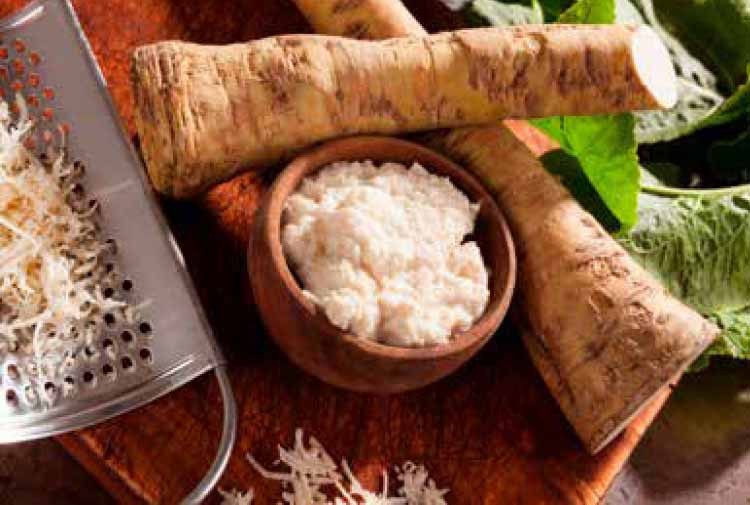
Horseradish grows into a robust plant with large, lobed green leaves and small white flowers. However, it is primarily known for its pale underground taproot. Cultivated varieties of horseradish do not produce seeds, meaning the plant can only be propagated by planting side roots. The roots are harvested in the autumn of the second year, with an average yield of 17 to 26 tonnes per hectare. In some regions, it is more common to harvest the roots after just one year, when they are finer. Today, horseradish is mainly cultivated in Hungary, Germany and Poland, with smaller growing areas in countries such as France and Belgium.
Historical use
The cultivation of horseradish dates back to early history. Some sources suggest that its first medicinal use already dates back to Ancient Egypt. During Roman times, the plant was described by Pliny the Elder under the name Armoracia, from which the genus takes its name. Horseradish was an effective remedy against scurvy due to its high vitamin C content, found in both the leaves and the root. From the late Middle Ages onwards, the use of horseradish became more widespread as it found its way into Jewish rituals.
Active compounds and contemporary applications
The characteristic sharp, pungent aroma of horseradish is released when the root is grated. Damage to the root causes the enzyme myrosinase to be released, which breaks down the high concentration of glucosinolates into volatile compounds such as isothiocyanates, responsible for the distinctive aroma. This is a natural defence mechanism against herbivores. Because of its intense pungency, horseradish is often used as a substitute for true wasabi in Japanese cuisine, sometimes combined with other ingredients to mimic the green colour. Genuine wasabi (Wasabia japonica) is expensive and more difficult to cultivate than horseradish. In addition, horseradish is widely used as a culinary spice in meat and fish dishes.
Less is known about the use of other plant parts, such as the leaves. Some sources mention the leaves as a leafy vegetable, but there is insufficient information available regarding their edibility and potential health risks. European legislation therefore only approves the use of the root in food products and food supplements. All other parts of the plant fall under the Novel Food category and may only be used after completing a Novel Food authorisation procedure, requiring explicit approval from EFSA based on scientific evidence of their safety and nutritional value.



